Showing posts with label Cuba. Show all posts

Friday, August 30, 2019

Sunday, April 17, 2016

Art exhibit Drapetomania: Grupo Antillano and the Art of Afro-Cuba. Past exhibition curated by scholar Alejandro de la Fuente.


Art exhibit Drapetomania: Grupo Antillano and the Art of Afro-Cuba. Past exhibition curated by Alejandro de la Fuente. 

Locations:
Galeria Universal, Santiago de Cuba (April- May 2013); Centro de Desarrollo de las Artes Visuales, Havana (August 3-31, 2013). New York City (Spring 2014), San Francisco (Fall 2014) and Cambridge, MA (Spring 2015). 


Wednesday, September 16, 2015

Sony Enters Historic Agreement to License Egrem's Catalog of Cuban Music


Billboard News
 
By Leila Cobo | September 15, 2015 4:30 PM EDT


Omara performs at the Portuondo Orquesta Buenavista Social Club Adios Tour Concert, Teatro Circo Price, Madrid, Spain on July 21, 2015.

Rex Features via AP Images


The most extensive catalog of Cuban music in the world will now have global reach.


More than 20,000 recorded tracks by the likes of Irakere, Los Van Van, Bola de Nieve, Ibrahim Ferrer and Omara Portuondo, among many others, will get new life thanks to a global licensing agreement struck Tuesday (Sept. 15) between Sony Music Entertainment and the Havana-based Egrem (Empresa de Grabaciones y Ediciones Musicales, or Enterprise of Recordings and Musical Editions in English).


With U.S. & Cuba Relations Thawing, Cuban Musicians Are Ready to Come to America


Egrem’s catalog, the most extensive catalog of Cuban music in the world, encompasses audio and audiovisual recordings produced since the 1960s.


Cuban "son" star Ruben Gonzalez, waves to the crowd as he performs traditional Cuban ballads at Salon 21 Sunday, March 7, 1999, in Mexico City. Gonzalez and Ibrahim Ferrer (not seen) leaped to international attention last year with release of the "Buena Vista Social Club" album that rescued from obscurity a whole generation of elderly Cuban "son" musicians. AP Photo/Jose Luis Magana

Although portions of the catalog have been licensed before by various labels in different parts of the world, this marks the first time a multinational has access to the entire stable of recordings for the whole world as part of a multi-year agreement.


“We are delighted to be partnering with EGREM to share for the first time one of the largest and most acclaimed catalogs of Cuban music with fans across the globe,” Sony Music Entertainment CEO Doug Morris said in a statement. “This landmark agreement will help expand international awareness and appreciation of Cuban culture, Cuba’s rich musical heritage and its many wonderful artists.”


Uncovering Cuba: An Inside Look at a Music Scene Opening Up to the World (Exclusive Video)

 
lthough the deal between Egrem and Sony had been in the works for over two years, it was only signed Sept. 15 in Havana by Afo Verde, Sony’s chairman and CEO for Latin America, Spain and Portugal, and Egrem managing director Mario Angel Escalona Serrano. Edgar Berger, Sony’s chairman and CEO, International, was also at the signing, which took place at Areíto studio 101, the fabled Havana studio where legendary Cuban and international artists have recorded since the 1940s.

“We see these agreements as an opportunity for the joint management of our catalog over the coming years,” said Escalona Serrano.

“We are working on the release of this treasure of Cuban music so it will be available on all possible music and video platforms for music lovers to enjoy as soon as possible,” said Verde.

Although the U.S. and Cuba have been in a process of normalizing their relationship since December 2014, and the two countries restored diplomatic relations this past July, the Sony-Egrem deal was subject to many required steps.

Sony entered into the transaction pursuant to the “informational materials” exemption under U.S. sanction rules for Cuba administered by the Office‎ of Foreign Assets Control (OFAC). This exemption applies to music and other works of art, and is intended to promote the free movement of information and artistic expression by the Cuban people.


For Sony, the Egrem license, at a time when relationships between Cuba and the U.S. have finally opened up, is a major coup.


“Sony Music is honored to bring this iconic music -- representing over five decades of Cuban culture -- to all corners of the world,” said Berger. “We are thrilled to introduce these extremely talented artists to the global audience they so richly deserve.”

Thursday, September 10, 2015

The Brown University Latin Jazz and Pop Festival. October 1-7, 2015


The Brown University Latin Jazz and Pop Festival 


October 1-7, 2015.  Providence, Rhode Island


Event Calendar


Thursday, October 1

- 4:00 p.m. Lecture on the Historical Roots of Contemporary Afro-Cuban Music by Ned Sublette, Kim Koo Library, Watson Institute, 111 Thayer St.


- 9:00 p.m. Afro-Cuban Rumba

Renowned percussionists Pedrito Martinez, Raymer Olalde, Philbert Armenteros and Roman Diaz will offer an unforgettable performance at The Spot Underground.

Reserve your FREE tickets here!

Afro-Cuban Rumba


Friday, October 2

- 12:00 p.m. Roundtable on Contemporary Afro-Cuban Pop and Jazz, with Ned Sublette, Arturo Gomez, Martin Cohen, and Eva Silot Bravo, Joukowsky Forum, Watson Institute, 111 Thayer St.

Musicologist Ned Sublette, author of the definitive Cuba and Its Music will be joined by Martin Cohen, founder of the Latin Percussion (LP) brand of percussion instruments; Arturo Gomez, KUVO/KVJZ Music Director, Host of Lunchtime at the Oasis, and Community Camp; Cultural Affairs Liaison; and Phd. Candidate at University of Miami, Researcher and Blogger Eva Silot Bravo (Cubanidadinbetween).


- 8:00 p.m. An Evening of Latin Jazz with Ed Calle and Friends, The Spot Underground, 180 Pine St.

Ed Calle is a renowned musician, composer, orchestrator, scholar, professor, and leader. Throughout his legendary career, Calle has become one of the most recorded saxophonists in history appearing on more than 1,200 albums, 8,500 singles, and countless television and movie soundtracks with artists ranging from Frank Sinatra and Celia Cruz to Sylvester Stallone and Andy Garcia.


Reserve your FREE tickets here!

Ed Calle


- 10:00 p.m.-12:00 pm Son Lokos, The Spot Underground, 180 Pine St.

SonLokos is a new Cuban dance band based in Miami that features renowned percussionists Raymer Olalde and Philbert Armenteros.

Reserve your FREE tickets here!

Son Lokos


Saturday, October 3

- 3:00-4:30 pm, Percussion Workshop with Philbert Armenteros and Raymer Olalde, The Spot Patio, 180 Pine St.


(PRE-REGISTRATION REQUIRED- email clacs@brown.edu)

Drumming Workshop


- 9:00 p.m. Jesus Andujar and Grupo Sazon, The Spot Underground, 180 Pine Street

Providence's own Jesus Andujar & Grupo Sazon will kick off this great night of live music at The Spot with salsa, merengue, cha cha and Latin jazz.

Reserve your FREE tickets here!

Jesus Andujar


- 10:00 p.m. PALO! Performance, The Spot Underground, 180 Pine St.

PALO! is a 2015 Grammy Nominee and 2014 Latin Grammy Nominee as well as Miami New Times’ BEST LATIN BAND 2014.

“Afro-Cuban Funk is Cuban music for the new generation. And the leader of the sound is the Miami based band PALO!” New York Post

Reserve your FREE tickets here!
PALO!


Sunday, October 4

- 7:00 p.m. Day of Orula Celebration with Descemer Bueno, the Pedrito Martinez Group, Leslie Cartaya, Ed Calle, and the Brown University Jazz Band with Special Guest, PALO!

This very special evening will feature Cuban singer and composer Descemer Bueno, who won three Latin Grammy Awards in 2014, including “Song of the Year” for “Bailando”; master percussionist Pedrito Martinez, who Wynton Marsalis calls a “genius” and Quincy Jones praises as “the real thing”; the Grammy and Latin Grammy-nominated Afro-Cuban funk group PALO!; and the Brown University Jazz Band.

Granoff Performing Arts Center, Martinos Auditorium

Reserve your FREE tickets here!
Descemer Bueno


Pedro Martínez Group

Leslie Cartaya


Wednesday, October 7

- 8:00 p.m. Performance by Gina Chavez Trio (Indie Latin Folk-Rock), The Spot Underground, 180 Pine St.

Gina Chavez is a bilingual Latin-folk singer/songwriter who blends the sounds of the Americas with tension and grace. Her latest independent release, Up.Rooted, is a passionate collection of bilingual songs traversing cumbia, bossa nova, vintage pop, reggaeton, and folk combined with dynamic vocals and sharp social commentary.

The album won the praise of National Public Radio (NPR), USA Today, and The Boston Globe, and topped the iTunes and Amazon Latin charts after a feature on NPR’s All Things Considered. She is the 2014 John Lennon Songwriting Contest (JLSC) Grand Prize Winner for her song “Siete-D,” a rock-cumbia-rap mix that explores the delights and dangers of El Salvador from a window on the 7-D, the bus route she rode as a volunteer there in 2010.

Reserve your FREE tickets here!

Gina Chavez Trio

Saturday, August 1, 2015

Coco Fusco—THE REVOLUTION IS DEAD—BUT LONG LIVES THE STATE!


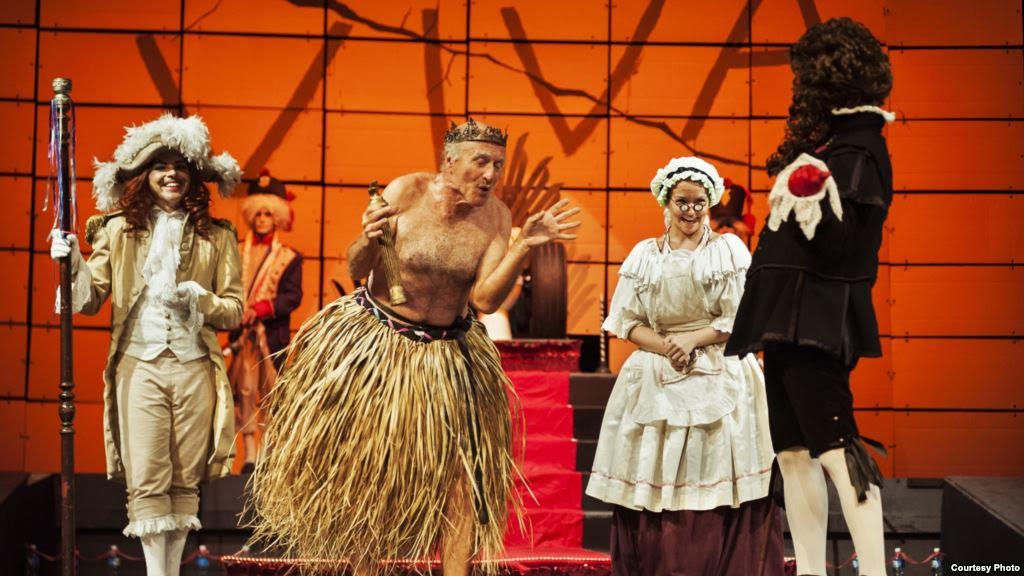
Juan Carlos Cremata’s production of The King Exits, a play by Ionesco, was recently censored in Cuba.

Published on e-flux
On the eve of the restoration of diplomatic relations between Cuba and the United States after a half-century standoff, I paid a visit to the Solidarność Museum in Gdansk. The museum’s permanent exhibition is an encyclopedic display of documents, videos,artifacts, and photographs detailing the rise of the independent trade union in the adjacent shipyard, the repressive response of the Soviet and Polish authorities, and the spread of popular resistance that, we are to understand, led to the end ofCommunism in the East. Though Solidarność’s retreat from politics in the 1990s and Poland’s transformation into a neoliberal economy with an ever-widening gap between low wages and high prices are absent from the story told by the museum, I found it hard to feel cynical about the heroic tale of righteous workers who spearheaded a peaceful revolt against oppressive state authority.Who among the world’s downtrodden wouldn’t want what these workers asked for?

Solidarność’s original twenty-one demands read like a blueprint for a utopian society, a kind of socialism without fangs in which workers could organize, strike, and also get raises, where free speech was enshrined, affordable food and housing were guaranteed together with paid maternity leave, and the bosses’capacity to skew managerial policies in their favor was checked.

The workers’ demands not only inspired compatriot intellectuals to assist them but also opened the door to a radical art fringe—the Orange Alternative—that staged irreverent street performances in defiance of authoritarian rule.

While many Cuban intellectuals also hoped for a political transformation in the 1980s, the Caribbean island’s leadership managed to ward off the end of socialism by stepping up repression and blaming the US embargo for its financial woes, rather than its own inefficiencies and political miscalculations.The Cuban government responded to the withdrawal of Soviet subsidies by authorizing a few small businesses and decriminalizing hard-currency possession, which led to the return of farmers’ markets, the emergence of home-based restaurants and barber shops, and a steady increase in remittances from exiles. Nonetheless, in the early 1990s, as food and power shortages dominated daily life, the value of wages plummeted and a wave of censorship hit the cultural sector. Cuban professionalsand artists left in droves. At the height of Cuba’s post-Soviet crisis, mass emigration on makeshift rafts for those who had no invitation to travel abroad was cynically encouraged by the state. It was not until Hugo Chavez took power in Venezuela and began supplying cheap crude oil to the Castro government that the island’s economy stabilized.

Nowadays, Cuban dissidents supported by the Lech Walesa Institute Foundation travel to Poland and visit the Solidarność exhibit, consult with former leaders of Eastern European opposition movements, and enjoy high-speed internet access free of charge at the embassies of former socialist block countries.They look to Eastern Europe for models and methods. They swaptales about growing up with Russian cartoons and black-marketvendors, and about contending with secret police andimpenetrable bureaucracy. But the comparisons stop there.

Cuban socialism was not imposed by a foreign power, nor can its government be characterized as a Soviet puppet. As historian Lillian Guerra has shown in her masterful study Visions of Power inCuba: Revolution, Redemption and Resistance, 1959–1971, the majority of Cuban citizens willingly relinquished their civil rights in the early stages of the revolution, believing that this was necessary to safeguard the country from foreign-backed threats to national security. The grand narrative about an underdog standing up to a foreign oppressor belongs to the Cuban government, with its anti-imperialist rhetoric and its invectives against the US embargo.While the middle and upper classes that fled to Miami are famous for their anti-Communism, the nationalist bent of the Cuban revolution and its dependence on a single charismatic leader who set policy via televised decree for fifteen years before approving a constitution made the tropical version of socialism quite different from any other.

Cuban dissidents are not trade unionists—they are intellectuals and professionals, many of whom fell out with the regime, and in some cases they are family members of political prisoners. The main audience for their muckraking remains outside the country and their attempts to intervene in Cuban public life are met with harsh responses from police and vituperative media campaigns instate media that dismiss them as mercenaries. No opposition group boasts membership as large as Solidarność once had—only one broad-based effort to bring about constitutional reform took root in Cuba in the 1990s and its leaders were soon imprisoned; its founder, Oswaldo Payá, died in a mysterious car accident in 2012.The common adage among Cuba’s critics is that the only way citizens can truly express their political will is by leaving the country.

Revolutionary rhetoric aside, Cuba’s economy is closer to state capitalism than centralized state socialism. The country’s public sector has been shrinking since the Soviet Union withdrew subsidies in the 1990s, while joint enterprise with SouthAmerican, Canadian, and European companies has grown. Privatization in the economic sector, however, has not been coupled with political liberalization, a point that is often made by critics of the Obama Administration’s new policy. There are many reasons why Washington may actually prefer to keep the current regime in power in Cuba. Unlike Eastern Europe, which enjoyed broad support from cold warriors in the US and Western Europe for its popular opposition to Soviet-style governance, Cuba operates in a post–Arab Spring geopolitical arena. Western powers are wary of popular uprisings and destabilized authoritarian states, which may explain why the Obama Administration appears so keen to negotiate with the Cuban regime instead of seeking to topple it. Indeed, despite the widespread belief that Cuba’s transition is imminent, the main player in the process is the current leadership, not the opposition. What is changing then is US-Cuba policy, not the Cuban government. Human rights are a bargaining chip, not a game changer in the discussion. Cuban dissidents may have racked up human-rights awards in Europe and they may enjoy photo ops with American politicians, but they do not command a mass following inside the country. Nor are they being groomed for future leadership. The Cuban government knows that it has the upper hand. Many Cuban dissidents have expressed anger and a sense of betrayal because realpolitik is not what they expected from Washington.

Since the December 17, 2014 announcement of a rapprochement between the US and Cuba, the political discussion in English has centered on who is perceived to have the upper hand in the negotiations. Unfortunately, the lack of nuance in most English-language reportage has encouraged many to confuse the announcement of renewed diplomatic ties with the termination of the US trade embargo, which it is not. Promised changes for Cubans, such as the expansion of internet services and the termination of a dual currency system in which most salaries are paid in worthless non-convertible pesos, have yet to materialize. But changes in the ways that Cubans see and speak about themselves have been taking place over the past decade.

Thanks to the development of citizen journalism on the island, Spanish-language media coverage offers more detailed and more critical accounts of the Cuban political apparatus and the country’s social ills, it's crumbling infrastructure, and its invasive policing practices. An expanding blogosphere led by a young generation of tech-savvy writers and activists has provided readers outside Cuba unprecedented access to social commentary from unauthorized sources and has facilitated public debate between island-based commentators and exiled intellectuals.While dissident musicians, writers, and indie filmmakers lash out publicly against the Cuban government, the artists who benefit from the support of the state’s cultural apparatus for the most part have stayed out of political debates. One notable exception to this pattern is the controversial but highly regarded film and theater director Juan Carlos Cremata, whose recent dramatic production of Eugène Ionesco’s Exit the King was shut down by authorities after one weekend on the boards. Apparently, a play about a four-hundred-year-old king whose kingdom is crumbling was too dangerously close to Cuban reality for their liking.

Cremata responded to the censorship by immediately publishing a scathing critique of state power in relation to the arts sector on numerous opposition blogs, and even granted an interview to Radio Martí in Miami. Visual artists are generally not so bold.They were among the first cultural producers in Cuba to be able to earn in hard currency and to negotiate independently with foreign entities; many enjoy a lifestyle that is envied by most Cubans. The beneficiaries of such privileges take a pragmatic approach to engaging both with the Cuban state and the global art market. Indeed, most of Cuba’s artists share their government’s desire for greater access to the global marketplace and its reticence to discuss human rights. Those who speak out about restrictions on speech, movement, and political conduct have either always been marginalized, or have fallen out of favor and have less to lose.Culture in today’s Cuba is a profitable business and complaining about civil rights is tantamount to being a wet blanket at a wild party. American collectors, who are flocking to the island in search of bargains, are happy to find a cadre of smart young artists poised and ready for business and seemingly uninterested inpolitics.

The Obama Administration has just removed Cuba from its state-sponsored terrorism list, giving the island greater access toforeign trade. Washington has also taken other measures that increase capital flow to the island, easing the economic pressure that failed to bring about systemic collapse or regime change. Up to now the Cuban government has only agreed to the original prisoner swap and the reopening of embassies. It maintains its longstanding demands for the return of the Guantánamo base, the lifting of the embargo, and the termination of US-based pro-democracy programs. While the American media sings Cuba’s praises as a tropical paradise full of sunny beaches, colonial architecture, vintage cars, and skilled-but-low-paid workers, Raúl Castro insists regularly on Cuban television that the socialist character of the Cuban state is not up for negotiation. Cuban dissident groups prepare their proposals for new civil rights legislation and demand a referendum, but Washington does not appear to be pressuring Cuba on these issues. The rate of detentions of dissidents and activists on the island has not gone down as negotiations progress. Old-guard exiled conservatives grumble about the rapprochement, sensing their loss of decision-making power over US-Cuba policy, but a younger generation of Ivy League–educated Cuban-American neoliberals has aligned itself with the Obama Administration, trying to be first in line to invest in the Cuban economy if and when the embargo is lifted. Cubans on the island appear split between those who are trying to open small businesses and join the ranks of the island’s nouveau riche, and those who are figuring out ways to emigrate before the Cuban Adjustment Act, which grants Cubans who set foot on US soil automatic refugee status, becomes a thing of the past. Rates of immigration in the past five years have been higher than during any other period since the onset of the revolution. Those most vulnerable are the elderly subsisting on pensions, an increasingly large sector of a country with a very low birthrate and a high incidence of migration.

Among the growing number of art-world itinerants who visit Cuba, there are many who are still in love with an idea of what the revolution was, or whose critical views of US policy lead them to downplay the significance of the problems with the Cuban economy and the repressive excesses of the state. There are also many global art-market players who turn a blind eye to Cuba’spolitical apparatus just in the same way that they overlook the undemocratic character of the governments in China, the GulfStates, and Russia so as to keep their art business unsullied by political fracases. The Cuban cultural ministry has banked on this combination of economic rationalism and political naïveté for decades. The seductive power of a tattered ideology draws cultural tourism, while the market-oriented pragmatism of most art-world cognoscenti helps the Cuban cultural apparatus to promote its favored artists abroad and secure financial support that substitutes for dwindling state subsidies. Unlike Cuban athletes and dancers who leave the country in search of better pay and working conditions, Cuban artists fare better financially when they keep the island as their home base, enacting a drama of national belonging for a foreign audience. Even those who work outside Cuba as much as possible rush back “home” when the Havana Biennial takes place. In recent years, several artists who went into exile in the eighties and nineties have returned with state approval in order to benefit from the media attention and marketing effort of the biennial as well.

It is against this backdrop that the recent confrontation between artist Tania Bruguera and the Cuban government is best understood. Her thwarted attempts to perform in Havana’s Revolutionary Plaza coupled with her highly successful international media campaign to publicize her treatment at the hands of Cuban authorities have complicated the international celebration of the US-Cuba rapprochement by foregrounding the ways in which the Cuban state, which goes to great lengths to present itself to the world as an enabling cultural force, simultaneously functions as a repressive agent. Bruguera’s notoriety turned an otherwise routine exercise of state control over a heavily policed public space into a political melodrama about artistic freedom in a country where no one has the right to express themselves freely and where the policing of public conduct is simply not news. The ruckus in social media outside Cuba contrasted with the virtual public silence of the Cuban art community on the matter. State officials questioned not only her loyalty but also her status as a Cuban given the fact that she has lived abroad for many years. In response, Bruguera dug in her heels by insisting that she has always wanted to work in Cuba, even as she maintains residence in New York; teaches in France; and though her projects in recent years have focused on immigrants in the US, religious visions in Italy, and cocaine trafficking in Colombia. It appears that the case against Bruguera has been dropped as of this writing. Her passport, which had been held for six months by Cuban authorities, has been returned.

While Bruguera was held up in Cuba by authorities, she won a major cash award in the US, sold a work to MoMA, and was appointed artist in residence for the NYC Mayor’s office of Immigrant Affairs—benefits that have not gone unnoticed by her compatriots.

The international attention to Bruguera’s case no doubt shieldedher from the harsher treatment that opponents of the Cuban government routinely receive—her detentions were brief and physical mistreatment was minimal. Writer Angel Santiesteban was just released under terms of “conditional liberty” after serving a two-year imprisonment on what many believe are trumped-up charges.
Street artist Danilo Maldonado Machado (aka El Sexto) has been imprisoned awaiting trial for over six months. Several other political prisoners are serving sentences for producing political graffiti against the Cuban government, but their marks are not considered art. When Cuban human-rights activists have been beaten, arrested, given lengthy sentences for nonviolent offenses, or died on hunger strikes, news rarely appears inEnglish-language media and no one in the international art world jumps on a soapbox or signs a petition. Despite the good intentions of those in the art world who created a media storm around Bruguera’s case, the discussion never progressed beyond naive outrage at her having been censored, as if this were not standard practice in Cuba, and as if freedom of speech were never subject to limits in any part of the world. Commentary has been focused singularly on her situation as an artist whose freedom to create was curtailed, rather than considering the political question of how and why Cuba controls the public speech and public acts of its entire population via intimidation, brute force, and the rewarding of complicity. That failure to address the political dimension of artistic expression reveals the economic underpinning of the cries for freedom—in other words, what the global art world seeks is for its famous artists to be “free” to travel and peddle their wares, not for people in general to express their opinions.

The absence of a more analytical international discussion of civil rights in Cuba beyond the Cuban diaspora is also what enables the Cuban government and its supporters to discount Bruguera as a self-serving gadfly and reassert its authority. Cuban artists who cooperate with the system do not broach the subject as part of a tacit agreement that allows them to function professionally. Exiled intellectuals and dissident journalists do address these matters regularly, but foreigners interested in new economic prospects in Cuba ignore that discussion. Romantic Cuba-philes dismiss these concerns when they assume that the very existence of art on the island is evidence in itself of freedom. Insisting that “engagement”is the key to political change, many members of the global cultural elite forget that the Cuban government has been expert at cultivating and controlling its fellow travellers since 1959, and that those who deviate from an unquestioning support for the political order lose their status and access to power.

In the months between Bruguera’s first detention and the 2015 Havana Biennial, I was approached by numerous journalists who wanted quotes but did not want to consider the limits on speech for Cubans other than the artist they already knew. I was also approached by artists who felt torn between their desire to“commune with Cuba” and their sympathy for Bruguera. Not one of them wanted to discuss what Cuban laws govern acceptable public speech or behavior, or to consider what the current negotiations between the US and Cuba may actually result in for those who live in Cuba or for hundreds of thousands of Cubans dispersed throughout the world who have never worked for the CIA and do not advocate violent overthrow of the regime, but whose salient criticisms of the Cuban revolution are grounded in grim experiences of its darker side. The art-world globetrotters who have just “discovered” Cuba—yet again—are caught between two dreams: one in which artists are thought to be freer than the rest of humanity, and another in which Cuba and its revolution persist as a fantasy about a bearded, longwinded leader who liberated a third-world country from poverty and capitalism.

One way out of this impasse is to take a break from the media spectacle about Cuba as the hottest new destination and listen to poetic and political commentary on the current situation by Cubans themselves. In the coming months, a special issue of e-flux journal will publish translations of poems, letters, essays, and fiction by Cubans who think deeply, ironically, and sometimes hopefully about their country, wherever they may reside. To launch this effort, we’ve offered a poem by writer and political activist Orlando Luis Pardo Lazo about the psychological effects of living with a larger-than-life leader for more than five decades.


Published on e-flux


Wednesday, October 15, 2014

La Ruta de las Almas. Latest art project by Pavel Urquiza.


La Ruta de las Almas. 

Latest art project by Pavel Urquiza, remarkable Cuban singer-songwriter who is one of the leading producers of what I call the Transnational Cuban Alternative Music Scene (TCAMS): a network of Cuban singers, songwriters and academically trained musicians spread out allover the world, who migrated since the 1990's crisis in the island. For more than 20 years this network of musicians has been creating, recording, producing, collaborating, and fusioning with Cuban music across different cities of the world as its regular "modus operandi."


According to La Ruta de las Almas webpage: "This project travels through five countries speaking and collaborating with artists spanning over twelve nationalities. Our team has collected interviews, footage, and sound for the documentary and the songs I composed inspired by this  of coexistence. These twelve songs are about the connections I see and hear in the world - and about the past, present, and future explorers on this common path. "

 
They are about to finish the documentary, which is a serious research and reflexion about the music connections among the Americas, the Iberian Peninsula and the Mediterranean. It's a totally independent project where the protagonists are musicians from more than 20 countries, including but not limited to Argentina, Colombia, Cuba, España, Marruecos, Israel, Palestina.

They have launched a campaign to collect funds in order to finish this project. Those interested could support it by visiting La Ruta de las Almas website and/or FB page.