Showing posts with label Articles. Show all posts

Friday, August 30, 2019

Saturday, April 6, 2019

"Wilderness and Marginality of a Cuban intelectual in Pedro Juan Gutiérrez's novel Trilogía sucia de la Habana" (1998). Caribbean Studies. Vol 46. No. 2. July-December 2018.


Happy to see another article published, this time in the Caribbean Studies Journal, Vol. 46 No. 2, July-December 2018, by Instituto de Estudios del Caribe, Universidad de Puerto Rico.


This article is entitled "Wilderness and Marginality of a Cuban intelectual in Pedro Juan Gutiérrez's novel Trilogía sucia de la Habana (1998)", and is part of my PhD. Dissertation from 2016 at the University of Miami.

Click in the link bellow to access the text:


Abstract
The article explores how the novel Trilogía sucia de la Habana (1998), by Pedro Juan Gutiérrez, depicts the decline of the subject identity heavily constructed by the paternalist ideology, promises and morals of the Cuban nation-state during the revolutionary period. Instead, emptiness, loss of faith, despair and wild survival became distressing effects of the nineties crisis. Pedro Juan’s marginal existence, constrained agency and sense of lost time embodies a common place for many Cuban intellectuals, trapped in the absurdity of a chaotic national situation. With Trilogía, Gutiérrez re-imagines the Cuban nation at the turn of the century as a dystopian place of material decadence, dehumanization, revival of colonial stereotypes and a rough culture of daily survival by all means. In those circumstances, the present is the only time that really counts and the hypersexualizing of the body became the privilege space for individual agency. The novel moves the spotlight from the collective incarnation of the “New Man” in the official revolutionary propaganda, to the voice of forgotten individuals massively converted into marginal beings. This article dialogues with texts by scholars Odette Casamayor, Guillermina de Ferrari, José Quiroga y Esther Whitfield, and with theories by Pierre Bourdieu, Roberto Bolaño, Frantz Fanon and Stuart Hall.

Keywords: Pedro Juan Gutiérrez, Cuban narrative, post-socialist intellectual, decadence, marginality

Resumen
Este artículo argumenta que la novela Trilogía sucia de la Habana (1998), del escritor cubano Pedro Juan Gutiérrez, logra documentar el momento de declive masivo de la ideología paternalista, las promesas, la moral y los valores del sujeto y el estado-nación cubano del período “revolucionario”. La novela recrea el vacío, la pérdida de fe, el desespero y el estado de sobrevivencia salvaje que vivieron los cubanos como resultado de los demoledores efectos de la crisis económica de la década de los noventa en la isla. El estado de permanente existencia precaria, asfixia y pérdida del sentido del tiempo que experimenta Pedro Juan, el protagonista de la novela, es un reflejo del lugar común que representó la crisis para muchos intelectuales cuba-nos en aquellos momentos, atrapados en el absurdo del caos nacional. Con Trilogía, Pedro Juan Gutiérrez “re-imagina” a la nación cubana de cambio de siglo como un lugar dis-tópico, de decadencia material, deshumanización, de regreso a estereotipos coloniales y a una cultura feroz de sobrevivencia diaria. En esas circunstancias, el presente y la hiper-sexualización del cuerpo se convirtieron en espacios “privile-giados” para ejercer algún tipo de agencia individual. La narrativa de la novela desplaza el énfasis alcanzado por la encarnación colectiva del “próspero” “Hombre Nuevo” en la propaganda revolucionaria oficialista hasta el momento, hacia la voz de individuos marginales y olvidados en los que se convirtieron muchos cubanos súbitamente como resultado de la crisis. Este artículo dialoga con textos de acadé-micas como Odette Casamayor, Guillermina de Ferrari, José Quiroga y Esther Whitfield, y con teorías de Pierre Bourdieu, Roberto Bolaño, Frantz Fanón y Stuart Hall.
Palabras clave: Pedro Juan Gutiérrez, narrativa cubana, intelectual post-revolucionario, decadencia, marginalidad

résumé
Cet article postule que dans son roman Trilogía sucia de la Habana (1998), l’écrivain cubain Pedro Juan Gutiérrez rend compte du déclin que connurent l’idéologie paternaliste, les promesses, la morale et les valeurs personnelles, ainsi que l’état-nation cubain au cours de la période révolutionnaire. Le roman recrée le sentiment de vacuité, la désillusion, le désespoir et l’état de survie sauvage dont les Cubains firent l’expérience suite aux effets dévastateurs de la crise économique des années 90 sur l’île. Le sentiment d’une existence profondément précaire, d’asphyxie et de perte de repères temporels dont fait l’expé-rience Pedro Juan, le personnage principal du roman, reflète un lieu commun sur ce que la crise représenta pour de nombreux intellectuels cubains de l’époque, englués dans l’absurdité du chaos national. Avec sa trilogie, Pedro Juan Gutiérrez reconfigure la nation cubaine et la transplante dans un lieu « dystopique », mais aussi dans un autre siècle, de décadence matérielle et de déshumanisation, en proie, une nouvelle fois, aux clichés coloniaux et à une culture féroce de survie quotidienne. Dans une telle atmosphère, le présent et l’hypersexualisation du corps deviennent des espaces privilégiés pour que les Cubains puissent s’exprimer librement. La narration du roman déplace l’accent mis, ini-tialement, sur le modèle collectif de l’« homme nouveau » (« Hombre Nuevo »), prospère, selon la propagande révolutionnaire officielle, pour laisser entendre la voix des marginaux et des laissés-pour-compte, tous ces gens que de nombreux Cubains étaient devenus du jour au lendemain après la crise. Cet article s’inscrit dans la mouvance des travaux d’Odette Casamayor, de Guillermina de Ferrari, José Quiroga et Esther Whitfield, et reprend les théories de Bourdieu, Bolaños, Fanon et Stuart Hall.

Mots-clés : Pedro Juan Gutiérrez, narration cubaine, intellectuel post-révolution, décadence, marginalité


Friday, July 27, 2018


No. 13 de la revista académica Camino Real. Estudio de las Hispanidades Norteamericanas, del Instituto Franklin en la Universidad de Alcalá, España.

En este número me publicaron una reseña que hice al libro Diversión: Play and Popular Culture in Cuban America, del académico cubano-americano Alberto Sergio Laguna.

PDF


P


Friday, July 13, 2018

Lanzamiento de Alafia Creative Entertainment y del video "A CHI CHA RAO" de Sol + The Tribu. El Nuevo Herald

SoL + The Tribu

Lanzamiento de Alafia Creative Entertainment y del video “A CHI CHA RAO” de SoL + The Tribu

11 de julio de 2018 03:30 PM

Thursday, March 8, 2018

Where Jazz and World Music Become One, GroundUp Style. An article about GroundUp Music Festival.

BandShell, Miami Beach

Where Jazz and World Music Become One, GroundUp Style.

By Eva Silot Bravo, PhD. (All Rights Reserved)

GroundUp Festival Logo
The 2nd edition of GroundUp Music Festival took place at the North Beach Bandshell in Miami Beach, February 9-11, 2018. The festival was founded last year by the brilliant and talented Michael League, director of multi Grammy-winning band Snarky Puppy and the GroundUp music label. The three-day event took place each day within the Bandshell and surrounding oceanfront park from noon until 11pm – concerts alternating between two stages, as well as intimate artist-led workshops. After-concert jam sessions went late in the night at a nearby hotel.


Throughout the festival League played with numerous bands, mingling and integrating smoothly with any type of format and music performed by his invitees. After more than a decade of work including the days with Snarky Puppy at the University of Northern Texas, GroundUp feels like a vision come true for League. He has been touring all over the world and collaborating non-stop with some of the best young and established musicians from all artistic genres. At a time of critical shifting in the music industry, League is breaking ground on his own terms with an underground approach and a little help from some friends. He has put together an independent music label and this annual world-class music reunion in Miami, a city not usually part of jazz fest circuits. Addressing the audience, League repeatedly expressed his joy to hold this festival as a celebration and opportunity to collaborate and celebrate with friends whose music he truly enjoys. 
  
One of the festival’s highlights was Snarky Puppy’s daily performance to a packed, enthusiastic and educated crowd of music fans. You could easily feel a great vibe of collaboration among all musicians involved. Jazz was an important musical language at GroundUp fest. It was also the perfect excuse to promote a space for exchange and encounter among musicians and music lovers. In only two years, GroundUp fest has become an inspiring cultural enterprise that only seems to get better. 


The festival’s mind-blowing lineup created many memorable moments including a concert by Weedie Braimah and the Hands of Time. Weedie is a Ghanian-born, St. Louis- raised, world-class percussionist, who showcased an insane talent as a performer and bandleader. The music ensemble utilized handmade African instruments including Djembe drums, balafon, shekere and kora. The band unveiled a real passion, soul and musicianship in their electric fusion of jazz and funk with West African music. MonoNeon, Prince’s last bass player, added a colorful intervention to Weedie’s band. 

Weedie Braimah and the Hands of Time
After that, I thought it was going to be difficult to experience anything better. But my predictions were overruled. Most of the festival’s music acts were noteworthy, to the point of being difficult to choose a favorite. 

Roosevelt Collier
Roosevelt Collier offered another unforgettable experience. He put together an extremely powerful jazz/hip-hop/gospel/groovy music band. Closing your eyes during his band’s performance felt like being inside an African-American evangelist church in Harlem, Little Haiti, Miami, or elsewhere USA listening to the most exquisite gospel music crafted with a fulfilling organ sound. After a bridge, the music suddenly transported the audience to another mood. Collier’s band flawless and funky performance was matched by his soulful sound and great skills on a wood lap steel guitar, Nashville style. Roosevelt Collier gave an uplifting concert that could take the audience to unimaginable places.

Banda Magda workshop
Magda Giannikou’s appearances at the beach workshop and on stage were memorable. Born in Greece, she leads Magda Banda, a New York based multicultural band that engages with an array of genres from jazz, Greek folk, South-American music to French chanson.  She is also a multi talented musician, band conductor, composer and multilingual singer that speaks indistinctly in Greek, French, English and Spanish. For the workshop Magda was joined by a drum circle at the beach. In this interactive workshop the audience was divided into several groups. Madga acted as a conductor, providing different vocal lines to each group’s leader. The organized improvisation turned into a nice vocal adventure, creating another moment of connection and joy. Later that night, she played at the Bandshell stage, joined by other Snarky Puppy musicians as well as Emily Estefan on vocals, and legendary singer, guitar and tres guitar player Eliades Ochoa of Buena Vista Social Club fame.
Paris Monster
The Paris Monster concert was electrifying. Josh Dion, lead singer of this two-man band, sings like a rock star, jamming on keyboards with his right hand and the drums with his left hand and leg. You could say he is a percussionist for his incredible sense of rhythm and the beat driven feeling of his music, but that’s an understatement. Paris Monster’s music is an unexpected fusion of rock, pop, garage, and funk-infused with intriguing electronic and synthesizer effects. An attractive light show and fog enhanced Paris Monster’s concert.

Harold Lopez-Nussa Trio
Equally mesmerizing were the performances of recognized jazz musicians, like saxophonist Joshua Redmand, pianist Robert Glasper, percussionist Jojo Mayer, guitarist and artist at large Lionel Loueke, banjo master Bela Fleck, the Wood Brothers, and bassist Victor Wooten. The performance of C4 was a nice surprise. A virtuoso ensemble of cuatro guitars and electric bass brought out a Venezuelan folk flavor. West African rhythms and instruments were another important reference for some of the festival acts. Harold Lopez Nussa Trio was another delight. With a international career as a pianist and jazz musician, Harold has contributed an open-minded, renewed fusion between Cuban music and jazz taking place for the last 20 years on and off the island.

Becca Stevens 
Emily Estefan
The female lineup was robust and captivating, including artists like Concha Buika, Becca Stevens, Alina Ergibayan, Sirintip, Emily Estefan and Banda Magda, among others. Listening to Emily playing live was a lot of fun. She moves with ease between different music styles and displays great confidence on stage. Emily is a Berklee College of Music alum and a multitalented player of cymbals, drums, electric guitar, piano, and a serious singer. Moreover, her music is personal, unpretentious and solid, supported by a kickass band with Caribbean, American, Latin and Latin-American music backgrounds. Emily Estefan’s concert was testament to the richness and versatility of Miami’s alternative urban music scene. 

The festival workshop series was a plus. The audience and participants witnessed over- the-top master classes and music demonstrations. They were held by world-class music stars from the festival, like Victor Wooten, Michael League, Jojo Mayer, Béla Fleck, Lionel Loueke, the Wood Brothers, Joshua Redman and Robert Glasper. Intimate workshops at the beach were led by Weedie Braihma, Banda Magda, Becca Stevens, and Alan Hampton. 

Bela Fleck and Lionel Loueke

with Josh Dion (Paris Monster) and Michael League (Snarky Puppy)
with master bassplayer Victor Wooten
Legendary Banjo player Béla Fleck and African born- and currently Herbie Hancock’s guitarist- Lionel Loueke started their workshop improvising, and the conversation went from there. It was the first time they played together. On the surface it looks like they don’t have much in common, but that was not the case. The dialogue between the banjo, the electric guitar and their respective musical universes produced delightful rhythms, sounds, and conversations with the attentive crowd. Singer-songwriter Becca Stevens and bassist Alan Hampton created an intimate setting at the beach with the audience. They sang covers and songs accompanied by some little folk guitars. Between songs they held casual Q and A with the audience and shared anecdotes in an inviting and casual atmosphere.

Addressing a frequently-asked-question, Banda Magda’s director Magda Giannikou said it was difficult to define a name for the style of music acts at the festival. Instead, she found a simple and illustrative compromise: Music. On the same topic, internationally acclaimed and award-winning bassist, composer, singer Esperanza Spalding defined very eloquently what this festival’s music is all about. “…it’s people on the ground floor of music making, who said: ‘We want to create music and treat our fellow musicians with respect, love, and honor. There has to be a cross-pollination from the ground up, and that’s this festival. It’s so amazing.” 


The audience is resting in hammocks between sets.

African handmade instruments for sale
Festival's merchandise
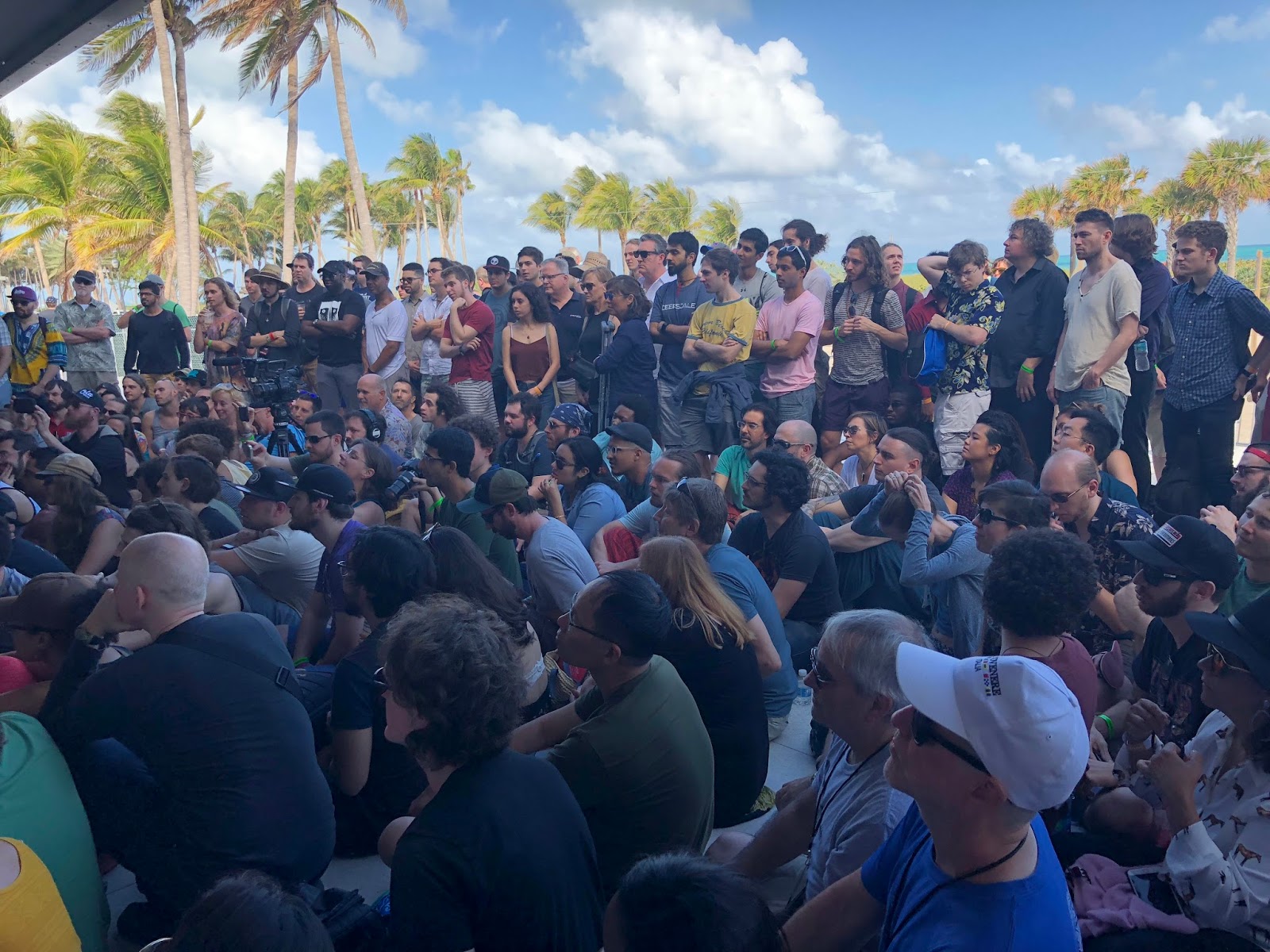
The festival’s production delivered efficiently and with great organization different details including the schedule, merchandise, lounge areas and food options. The set up offered many enticing options to relax on-site throughout the day. Perfect Miami Beach weather, enhanced by a breeze coming the sea, clear skies and sunshine made the festival experience a dream come true for attendees, many of whom were visiting from across the US and beyond.

The audience is listening to a workshop
Casual conversations emerged in different instances. I spoke with a local family of two middle-school kids with their parents. They heard about the festival last year, after listening to a Magda Banda album. They fell in love with it, became Snarky Puppy fans, and decided to attend the fest. A Canadian couple and a guy from North Carolina told me they were greatly surprised about the positive environment created by the GroundUp experience as something they want to continue to explore in the future. Others expressed their preferences for the fest to keep as is, mainly in terms of size. Few times I remember feeling so great to be part of an audience like this one. 
GroundUp Music Festival poster
The GroundUp Music Festival is definitely breaking ground for the alternative music scene. The festival celebrates music beyond boundaries, and it’s a great addition to Miami’s cultural and entertainment options. GroundUp is an excellent occasion to experience great live music by the sea, and to gain appreciation for musicianship.

By Eva Silot B., PhD. (All Rights Reserved)


Monday, February 5, 2018

Shadowman: El arte como obsesión trágica


Oscar van Gelderen
Por Eva Silot Bravo

El pasado fin de semana el O Cinema de Wynwood presentó la película Shadowman (2017), del director Oren Jacoby, en colaboración con el Art Center/South Florida. Con sus dos locaciones en Wynwood y North Miami Beach, el O Cinema se ha convertido en poco tiempo en un espacio regular para cinéfilos y amantes del arte en Miami, a través de sus atractivas muestras de cine y eventos dirigidos a diversas demográficas.
Ben Buchanan/Film Movement
El documental recrea la obra y vida del pintor Richard Hambleton a través de materiales de archivo, entrevistas y de un paciente trabajo de seguimiento al artista durante décadas. Hambleton fue un pionero, sobreviviente y el menos conocido de los protagonistas del street art en el convulso Lower East Side de la década de 1980s en New York, junto a Jean Michel-Basquiat y Keith Haring. A diferencia de estos, Hambleton sobrepasó su juventud y murió a los 65 años. No obstante, su vida estuvo marcada por problemas mentales, adicción y tránsitos abruptos, que lo llevaron a experimentar cíclicamente el éxito comercial y la indigencia, la fama y el aislamiento, el reconocimiento y el olvido. El documental muestra la obsesión de Hambleton por hacer arte bajo cualquier circunstancia a través de su trágica vida.

Hambleton recibió una educación formal como pintor en Vancouver, British Columbia. Su lenguaje estético empezó a ser reconocido en la década de los 70 a través de su recreación de 
escenas ficticias de crímenes en las calles, en las que pintaba siluetas salpicadas con pinturas que asemejaban el color de la sangre. Las siluetas rápidamente se convirtieron en su sello. La escena inicial en blanco y negro del documental nos muestra a Hambleton salpicado en pintura en las penumbras del Lower East Side, cargando un balde de pintura negra y una brocha a mano. De repente, se encarama en cualquier muro o rincón callejero, en donde pinta poderosas siluetas de color negro de  tamaño natural que pasaron a formar parte del paisaje urbano de New York. Sus siluetas se confundían con su figura, como si fueran una proyección de sí mismo. Las paredes de la ciudad fueron sus canvas favoritos, a pesar de que no consideraba su arte como grafiti. Sus siluetas llegaron a los cientos y se encontraban por doquier en lugares inesperados, creando sorpresa y misterio entre los transeúntes. Estas lo llevaron progresivamente al camino del reconocimiento y la fama.

Woodward Gallery
Este pionero del street art se convirtió en un ícono de la escena artística del downtown neoyorquino de los ochenta. Comenzó a reproducir sus siluetas en cuadros y su presencia se hizo notar en el mundo de las galerías, la televisión y la prensa. No obstante, en la cima de su carrera se “escapó” a Europa, dejando la huella de sus siluetas en rincones europeos en Londres, Venecia y en el Muro de Berlín. De la fama pasó a ser un outkast del arte neoyorquino. Luego de la muerte de Basquiat y Haring, Hambleton comenzó a rechazar el mundo de las galerías y su parafernalia mediática. Pintar se convirtió en su principal obsesión, y lo acompañaría por el resto de su vida.
Hank O' Neal

Jacoby documenta también la problemática relación de Hambleton con los dealers de arte, marcada por sus adicciones, sus problemas mentales, su naturaleza volátil y su personalidad victimaria. En una temporada pintó ininterrumpidamente por meses, creando un volumen importante de obras para un coleccionista, que luego lo estafó. Auto saboteó importantes oportunidades que se le presentaron por su hermetismo, su súbito deseo de desaparecer y aislarse, y su rechazo a la burbuja del mundo del arte, la misma que una vez le brindara legitimidad y reconocimiento. El documental recrea las recaídas de Hambleton como ciclos inefables en su vida, una y otra vez. En varias ocasiones fue desalojado y vivió en la calle durmiendo en rincones, lugares abandonados y especie de basureros atestados de ratas. En otra oportunidad unos coleccionistas le ofrecieron residencia en el Trump Tower a cambio de producir una pintura al mes. Su desequilibrio y su tendencia hacia el caos una vez más le sobrepasaron, y fue nuevamente expulsado a la calle. Sufrió una importante escoliosis que lo convirtió en un hombre de figura deforme. Convivió por años con un cáncer de piel que no quiso tratarse y que fue consumiéndole su cara, cuya imagen apenas tapada se va imponiendo a través del documental como su último legado. Su vida reforzó el mito del caos y la destrucción que puede acompañar al éxito y la fama.

Desapareció por 20 años del mundo del arte hasta su estridente regreso en el 2009, gracias al interés de dos galeristas que, asociados a Giorgio Armani, organizaron su relanzamiento en New York y Europa. Su novia lo apoyaba y lo acompañó durante años. Es a través de los comentarios de ella en el documental que entendemos las circunstancias trágicas que rodearon a Hambleton, no solo como víctima del mercado del arte. Su vida transcurrió entre su obsesión por hacer arte en cualquier rincón y su naturaleza autodestructiva por su adicción a las drogas y sus problemas mentales. En ocasiones Hambleton llegó a pintar cuadros con su propia sangre. En otros momentos repintaba sus cuadros una y otra vez, en el momento justo en que debían estar listos para ser exhibidos. En esta época y para él sus cuadros nunca estaban terminados.
Eva Silot Bravo
En la charla que siguió a la muestra de la película en O Cinema, el director hizo alusión a las dificultades del proceso de filmación. Nunca pudo obtener una entrevista directa de Hambleton. Más bien tuvo que “perseguirlo” pacientemente y adecuarse a sus altibajos durante años. En el documental, Hambleton nunca le dirige su atención al lente de la cámara y se esconde en varias ocasiones para no ser filmado. Todo ello llevó a que el director se cuestionara la posibilidad real de terminar su película. El filme documenta claramente el nefasto impacto de la drogadicción en el deterioro físico de este artista y en su carácter ambivalente. Sin embargo, no explora en profundidad el impacto de su enfermedad mental en su sórdido destino. Solo hacia el final, la novia de Hambleton brinda algunas pautas sobre su infancia, al parecer marcada por abusos familiares, lo que permite hasta cierto punto imaginar los orígenes de su agónica supervivencia y frágil estado mental. Shadowman es una atractiva y a la vez trágica crónica documental, que mantiene el interés del espectador hacia el proceso creativo y sombría existencia que marcó la vida y obra de este artista.

By Eva Silot Bravo. All Rights Reserved.