Wednesday, May 13, 2020

Miami Alternativo Videopodcast by Alafia Creative Entertainment & Artistnator-5 Chapters


Miami Alternativo es una serie limitada para podcast que surge de la colaboración entre Alafia Creative Entertainment y Artistnator.


Las entrevistas nacen a partir de la investigación de la Dra. Silot, fundadora de Alafia Creative Entertainment, y buscan presentar la visión de artistas en Miami y su relación con la cultura y el entorno que les rodea.


Nos encantó poder conversar con la Consue, referencia y maestra de tantos artistas cubanos. No todos los días se tiene la oportunidad de compartir espacio con una persona tan creativa e inteligente. La entrevista nos dejó saboreando esa visión aguda, aparente superficialismo con el que su obra coquetea, ese concepto y amor por la imagen movida y visual que transmite el lenguaje de Consuelo Castañeda.


Para conocer más sobre Alafia Creative Entertaiment:


Paraconocer más sobre Artistnator: http://artistnator.com/


1er Capitulo-Consuelo Castañeda


2do Capitulo- Niurka Marquez, Nu-Flamenco


3rd Chapter-Andrew Yeomanson-DJ SpamAllStars


4th Chapter-Sandra Ramos Lorenzo


Thursday, April 30, 2020

Word Culture-Cultura de la Palabra-Podcast-A Weekly Online Podcast-Chapters 1-10


Word Culture-Cultura de la Palabra
Un Podcast Semanal Online- A Weekly Online Podcast

Chapters 1-10

Bilingual: Español English

Conversations with Creatives-Conversaciones con Creativos

Fridays, 7 pm Viernes a las 7 pm

FB, Youbute, IG & Twitter.

Dra Eva Silot Bravo, Alafia Creative Entertainment and Blog Cubanidadinbetween


Chapter 1- Joe Cardona, Journalist and Film Director


Chapter 2-Sujal Sudarshan-Skylightyoga


Chapter 3- Joan Godoy-Radical Partners


Chapter 4-Neri Torres-IFE-ILE


Chapter 5. Kelly M. Grandal. Escritora, Editora, Poeta y Educadora.


Capitulo 6. Paloma Duenas. PalomaArts & OhmSessions


Chapter 7. Kevin Walton-Source Radiance


Chapter 8. Mio Santana. Divine Feminine Circle


Capitulo 9. Milvia Rodriguez-The University of Chicago.


Capitulo 10. Yesenia Selier- New York University


Saturday, November 9, 2019

Miami Alternativo-Podcast Limited Series-Bilingual-Spanish & English. Alafia Creative Entertainment in collab with Artistnator


by Eva Silot Bravo 


Miami Alternativo is a limited podcast series created by Dr. Eva Silot Bravo, founder of Alafia Creative Entertainment, in collaboration with Artistnator.


The series is based on Dr. Silot Bravo's doctoral research on alternative and transnational art scenes in Miami and other world cities, including Havana, published as a doctoral dissertation by the University of Miami since August 2016. 


Miami Alternativo proposes 5 interviews to remarkable local and transnational talents Consuelo Castaneda, Sandra Ramos, Niurka Marquez, DJ Spam All Starts-Andrew Yeomanson, and Leslie Cartaya. 


These artists represent a sample of the amazing number of international outstanding talents who call Miami home and have been enriching the local art scenes in the visual arts, dance and movement, cultural promotion, non-profit, dance, live arts, music production, and performance.


These artists have developed oustanding professional and personal careers beyond mainstream markets, locally and transnationally. 


They are truly inspirational, by the level of mastering they have achieved in their artistic lives, and by being on the move, constantly updating their creative paths with the contexts and time they have been living in.


photos by Artisnator

AudioFiles-To Listen to each of the 5 chapters, Please Click on the Description bellow each picture.


Enjoy and Please Leave your Comments on this Blog, and our Website, FB, IG & Twitter:

#alafiacreativeentertainment #blogcubanidadinbetween #evasilot #TCAMS #Cubanfusion 


5 episode. Interview to Grammy Nominated musician  Leslie Cartaya


Friday, August 30, 2019

Saturday, April 6, 2019

"Wilderness and Marginality of a Cuban intelectual in Pedro Juan Gutiérrez's novel Trilogía sucia de la Habana" (1998). Caribbean Studies. Vol 46. No. 2. July-December 2018.


Happy to see another article published, this time in the Caribbean Studies Journal, Vol. 46 No. 2, July-December 2018, by Instituto de Estudios del Caribe, Universidad de Puerto Rico.


This article is entitled "Wilderness and Marginality of a Cuban intelectual in Pedro Juan Gutiérrez's novel Trilogía sucia de la Habana (1998)", and is part of my PhD. Dissertation from 2016 at the University of Miami.

Click in the link bellow to access the text:


Abstract
The article explores how the novel Trilogía sucia de la Habana (1998), by Pedro Juan Gutiérrez, depicts the decline of the subject identity heavily constructed by the paternalist ideology, promises and morals of the Cuban nation-state during the revolutionary period. Instead, emptiness, loss of faith, despair and wild survival became distressing effects of the nineties crisis. Pedro Juan’s marginal existence, constrained agency and sense of lost time embodies a common place for many Cuban intellectuals, trapped in the absurdity of a chaotic national situation. With Trilogía, Gutiérrez re-imagines the Cuban nation at the turn of the century as a dystopian place of material decadence, dehumanization, revival of colonial stereotypes and a rough culture of daily survival by all means. In those circumstances, the present is the only time that really counts and the hypersexualizing of the body became the privilege space for individual agency. The novel moves the spotlight from the collective incarnation of the “New Man” in the official revolutionary propaganda, to the voice of forgotten individuals massively converted into marginal beings. This article dialogues with texts by scholars Odette Casamayor, Guillermina de Ferrari, José Quiroga y Esther Whitfield, and with theories by Pierre Bourdieu, Roberto Bolaño, Frantz Fanon and Stuart Hall.

Keywords: Pedro Juan Gutiérrez, Cuban narrative, post-socialist intellectual, decadence, marginality

Resumen
Este artículo argumenta que la novela Trilogía sucia de la Habana (1998), del escritor cubano Pedro Juan Gutiérrez, logra documentar el momento de declive masivo de la ideología paternalista, las promesas, la moral y los valores del sujeto y el estado-nación cubano del período “revolucionario”. La novela recrea el vacío, la pérdida de fe, el desespero y el estado de sobrevivencia salvaje que vivieron los cubanos como resultado de los demoledores efectos de la crisis económica de la década de los noventa en la isla. El estado de permanente existencia precaria, asfixia y pérdida del sentido del tiempo que experimenta Pedro Juan, el protagonista de la novela, es un reflejo del lugar común que representó la crisis para muchos intelectuales cuba-nos en aquellos momentos, atrapados en el absurdo del caos nacional. Con Trilogía, Pedro Juan Gutiérrez “re-imagina” a la nación cubana de cambio de siglo como un lugar dis-tópico, de decadencia material, deshumanización, de regreso a estereotipos coloniales y a una cultura feroz de sobrevivencia diaria. En esas circunstancias, el presente y la hiper-sexualización del cuerpo se convirtieron en espacios “privile-giados” para ejercer algún tipo de agencia individual. La narrativa de la novela desplaza el énfasis alcanzado por la encarnación colectiva del “próspero” “Hombre Nuevo” en la propaganda revolucionaria oficialista hasta el momento, hacia la voz de individuos marginales y olvidados en los que se convirtieron muchos cubanos súbitamente como resultado de la crisis. Este artículo dialoga con textos de acadé-micas como Odette Casamayor, Guillermina de Ferrari, José Quiroga y Esther Whitfield, y con teorías de Pierre Bourdieu, Roberto Bolaño, Frantz Fanón y Stuart Hall.
Palabras clave: Pedro Juan Gutiérrez, narrativa cubana, intelectual post-revolucionario, decadencia, marginalidad

résumé
Cet article postule que dans son roman Trilogía sucia de la Habana (1998), l’écrivain cubain Pedro Juan Gutiérrez rend compte du déclin que connurent l’idéologie paternaliste, les promesses, la morale et les valeurs personnelles, ainsi que l’état-nation cubain au cours de la période révolutionnaire. Le roman recrée le sentiment de vacuité, la désillusion, le désespoir et l’état de survie sauvage dont les Cubains firent l’expérience suite aux effets dévastateurs de la crise économique des années 90 sur l’île. Le sentiment d’une existence profondément précaire, d’asphyxie et de perte de repères temporels dont fait l’expé-rience Pedro Juan, le personnage principal du roman, reflète un lieu commun sur ce que la crise représenta pour de nombreux intellectuels cubains de l’époque, englués dans l’absurdité du chaos national. Avec sa trilogie, Pedro Juan Gutiérrez reconfigure la nation cubaine et la transplante dans un lieu « dystopique », mais aussi dans un autre siècle, de décadence matérielle et de déshumanisation, en proie, une nouvelle fois, aux clichés coloniaux et à une culture féroce de survie quotidienne. Dans une telle atmosphère, le présent et l’hypersexualisation du corps deviennent des espaces privilégiés pour que les Cubains puissent s’exprimer librement. La narration du roman déplace l’accent mis, ini-tialement, sur le modèle collectif de l’« homme nouveau » (« Hombre Nuevo »), prospère, selon la propagande révolutionnaire officielle, pour laisser entendre la voix des marginaux et des laissés-pour-compte, tous ces gens que de nombreux Cubains étaient devenus du jour au lendemain après la crise. Cet article s’inscrit dans la mouvance des travaux d’Odette Casamayor, de Guillermina de Ferrari, José Quiroga et Esther Whitfield, et reprend les théories de Bourdieu, Bolaños, Fanon et Stuart Hall.

Mots-clés : Pedro Juan Gutiérrez, narration cubaine, intellectuel post-révolution, décadence, marginalité


Wednesday, January 9, 2019

Are We in Miami? Art Basel, PLAZA and the local creative scene.


text and photos by Eva Silot Bravo, Ph.D. 
Alafia Creative Entertainment

All Rights Reserved

Art Basel was once again at full swing last December, bringing with it hectic traffic, art lovers, fashionistas, celebrities and travelers from all over the world. Creative locals and visitors were frenetically immersed into art shows, partying, taking pictures, and making their way from one place to another and exploring every corner of Wynwood, the Design District, Little Haiti, Miami Beach, and the River District, among other areas. Wherever you go, there was euphoric energy of curiosity and celebration.

Basel has certainly contributed to make Miami a more international urban hub, but that's not the only element on this equation. For decades Miami has been an epicenter for global migration, real estate investment, and mobility. Millennials are an increasingly dynamic and visible sector of the local workforce, driven by the dynamism and autonomy brought by the digital market. Several art districts, nonprofits, startups, and business incubators are booming and have established offices in the city. Particularly in the last decade, there has been a sustained focus on art and creative philanthropy by organizations like the Knight Foundation, the Miami Foundation, and the support of local government institutions like the City of Miami Beach and the Miami Dade Department of Cultural Affairs.
   
Art Basel Miami 2018 was an opportunity to experience first-hand the effervescence of the local creative arts scene, with the happening of diverse free or affordable parallel art fairs, the opening up of local artist studios, in site installations, interdisciplinary performances, collab spaces and neighborhood tours beyond the circuit of mainstream fairs. The influx of creative energy brought by these local events felt like déjà vu scenes of artistic sections of Brooklyn and other New York neighborhoods.


PLAZA was one of the most stimulating local art events I had the opportunity to attend this year during pre-Basel events. The in-site performance was created by local and awarded dance choreographer Liony Garcia and commissioned by Grass Stains, an initiative to mentor original site-specific art initiatives by the Pioneer Winter Collective. As with many other great artistic projects in the city, PLAZA was supported by the Knight Foundation.

Liony Garcia and the Pioneer Collective are among the protagonists of a vital movement of local artists, nonprofits and cultural institutions like Flamenco Nu, Bistoury, O Cinema, the Koubek Center, Wynwood Yard, Miami Light Project, Las Rosas, Little Haiti Cultural Center and many others that regularly present high quality, interdisciplinary and socially conscious art projects. As pioneers in the local art scenes, they have navigated and sorted out important obstacles, such as a lack of systematic interest in the development of local talent; having to work other jobs to sustained themselves; breaking up certain habits in the local art ecosystem that mainly present “the usual suspects”; and the lack of a more diverse, cross-cultural and up to date art critic, more responsive to the important shifts taking place in the city’s cultural landscape.


PLAZA was an in-site work and dance performance presented at Chicago Produce, a real produce warehouse in Allapattah, an old gentrified neighborhood and commercial warehouse district in the northwest area of Miami. The warehouse was not only the venue where PLAZA took place. Warehouses have become among the main urban spaces in Miami where local art is being made, artists gather and rehearse, art pieces are kept and commercialized; and where many arts, music, TV, radio, and film studios are located. Warehouses also define many emerging art districts across the city. In Miami, the warehouse has become probably the most important icon to represent the local culture in the last decade prompted by Art Basel.

When the audience arrived at Chicago Produce we had to wait outside for a little while. We were really curious and expectant, without really knowing what we were about to experience. Then we were divided into three main groups with assigned numbers. The expectation just increased. Then, the “workers” showed up, eight dancers dressed up in working attires highlighting primary colors. They guided the audience all the way to the back and throughout the different spaces of the warehouse, including a freezer compartment. The worker-dancers indistinctly walked or moved around, either carrying bags and boxes of produces, cleaning, driving machinery, checking inventory, loading, and unloading cars, always in a robotic and repetitive fashion. 

Most of the produce was organized throughout the location in bags and colorful boxes that, together with the workers’ clothing, produced an in-site Disney coordinated type of visual experience on display. Throughout the performance, the dancer-workers were always doing mechanical and repetitive movements and dance sequences back and forth with the produces, in a seemingly Chocolate Factory’s style. Their gazes were lost and unattainable, keeping a sordid smile at all times that suggested a forced complacency and unreal joy for the “work” they were doing. The dancer-workers acted like faceless and meticulous modern slaves, modeled by an inherent sense of order, control and efficiency. 


The soundscape created by the music selection was clever, in particular towards the end of the piece, where the dancer-workers collectively danced a feverish and happy choreographed salsa music. The scene reinforced the irony of the simulated cheerful working atmosphere. PLAZA tuned in the audiences with a high vibe of searching, exploration, and improvisation in the most unexpected venue.

Not only PLAZA suggested a critic to Miami’s visible process of gentrification and displacement of historic neighborhoods and people in the last decades.  From a smart and ironic gaze, this meticulous in-site work made visibly and questioned the culture of extreme efficiency and stress experienced by a good part of the local working force throughout the city. 

For Liony, PLAZA was imbued with a personal touch. As many children in Miami, Leony hardly saw his father during his childhood, due to his hectic schedule working for this kind of business. Hence, Liony considers this piece as a personal tribute to his family and the city, a reflection on how much labor is involved in our lifetimes, particularly in warehouses. Ultimately, PLAZA was a due homage to the local working class and  “to the bigger economy of how things work.”


Undoubtedly, interdisciplinary art projects like PLAZA illustrated how much the city’s creative sector has benefited from the “Basel effect”.  For local pioneers like Liony, Art Basel was a great opportunity as a forum for an exchange of ideas among artists to experience and inform their creative process with was is going on in the art scenes globally. In his opinion, the yearly happening of the global art fair in Miami definitely nourishes the city, as a great platform for interdisciplinary work and networking with the international creative class.

However, the increasingly and constant flux of diverse artists, transnational creatives and multicultural voices who call Miami their home and that are contributing to its growth, calls for the need to make the local art ecosystem far more reaching and sustainable. There's a need to promote a comprehensive, coordinated, transparent inventory and wider access to information of the existing and upcoming resources and opportunities available to local creatives, beyond the traditional and usually closed up existing art networks.

Alafia Creative Entertainment
Love for Learning through the Arts

Friday, July 27, 2018


No. 13 de la revista académica Camino Real. Estudio de las Hispanidades Norteamericanas, del Instituto Franklin en la Universidad de Alcalá, España.

En este número me publicaron una reseña que hice al libro Diversión: Play and Popular Culture in Cuban America, del académico cubano-americano Alberto Sergio Laguna.

PDF


P


Saturday, July 21, 2018

My company's webpage- Alafia Creative Entertainment.


My company’s website (first phase) is out.

 Please help me share the link & spread the word. Thanks. 🙏❤️🎶


La página web de mi compañía está lista en su primera parte. 
Ayúdame a compartir el link y regar la voz. Gracias.👌🏽


Friday, July 13, 2018

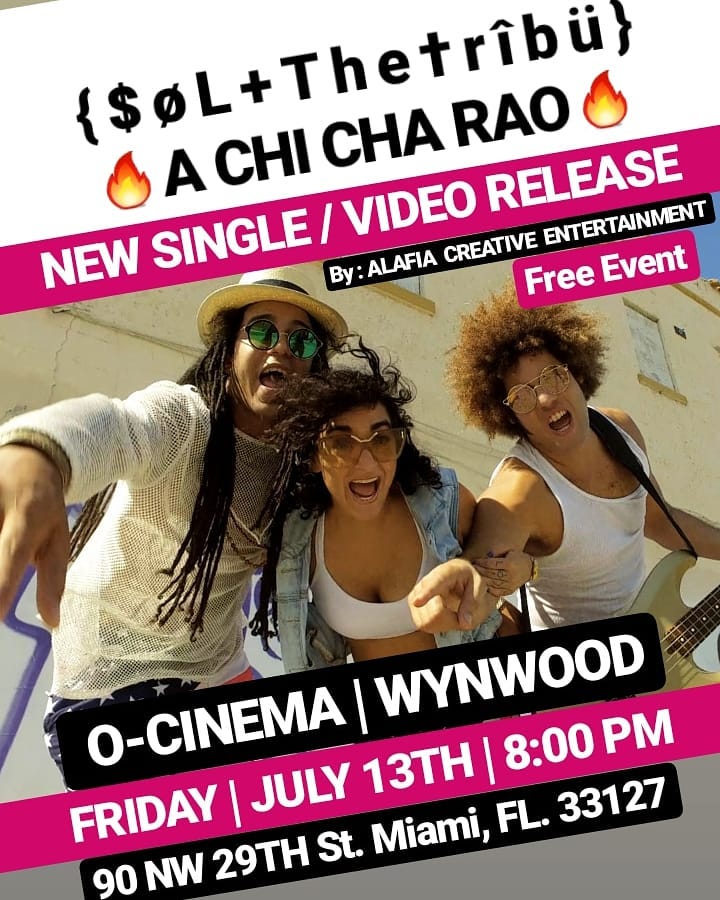
Lanzamiento de Alafia Creative Entertainment y del video "A CHI CHA RAO" de Sol + The Tribu. El Nuevo Herald

SoL + The Tribu

Lanzamiento de Alafia Creative Entertainment y del video “A CHI CHA RAO” de SoL + The Tribu

11 de julio de 2018 03:30 PM

Saturday, July 7, 2018


PRESS RELEASE


ALAFIA CREATIVE ENTERTAINMENT 
COMPANY LAUNCHING.

 SOL + THE TRIBU 
NEW SINGLE VIDEO RELEASE 
“A CHI CHA RAO”. 

FRIDAY, JULY 13th, 8:00 PM. OCINEMA- WYNWOOD. 
90 NW 29th St. Miami, FL. 33127. 305-571-9970. 
Free and Open to the Public.


Alafia Creative Entertainment & O Cinema present a special event, on Friday, July 13th, 8:00 pm, at O Cinema Wynwood. The event will launch Alafia Creative Entertainment, a music business start-up in the Wynwood Arts District, Miami; and will release the new single video “A CHI CHA RAO”, by the sizzling local music collective Sol+ The Tribu.

Sol + The Tribu is a project born in Miami by Cuban musicians Sol Ruiz (Vocals/Guitar/Keyboard), Rey Rodríguez (Vocals/Guitar) and Manny Diaz (Vocals/Percussion).  Their unique Miami sound is a blend of Electronic music with Afro-Cuban rhythms, Cumbia, Reggaeton, Funk, Blues and Hip hop.  As a reflection of the place where they create, they sing in Spanglish, taking their influences from Benny More, Orishas, Fugees, Outkast and Celia Cruz, among others. They create a rhythmic landscape that blends the traditions and cultures around them. 

Critics describe Sol as the “female Manu Chao”, and stated that “she has the voice of Janis Joplin and Celia Cruz”. The Miami Herald named her “the Cuban Janis Joplin”, and she was appointed Miami's Songwriter of the Year in 2012.  Sol + The Tribu is her more recent music project. 

Alafia Creative Entertainment was founded by Eva Silot Bravo PhD., after more than 15 years of research and work experience in international relations, education, blogging and arts consulting. The company provides in demand, high quality and tailored music booking and arts consulting services. ACE specializes in transnational Cuban music fusion and the local alternative urban music scene.

This cultural enterprise is also developing projects on education and community outreach, through socially engaging and out of the box entertaining options. ACE is pursuing collaborative projects and joint ventures with business partners interested in the development and diversification of the local arts and music business scene. 

This event is Free and Open to the Public


Contact: Eva Silot, ACE, Director and Founder, for Press inquiries about this event: 786-523-3902 alafiacreativeentertainment@gmail.com.


 For Bookings, Proposals and any other inquiries, please email: alafiacreativeentertainment@gmail.com